
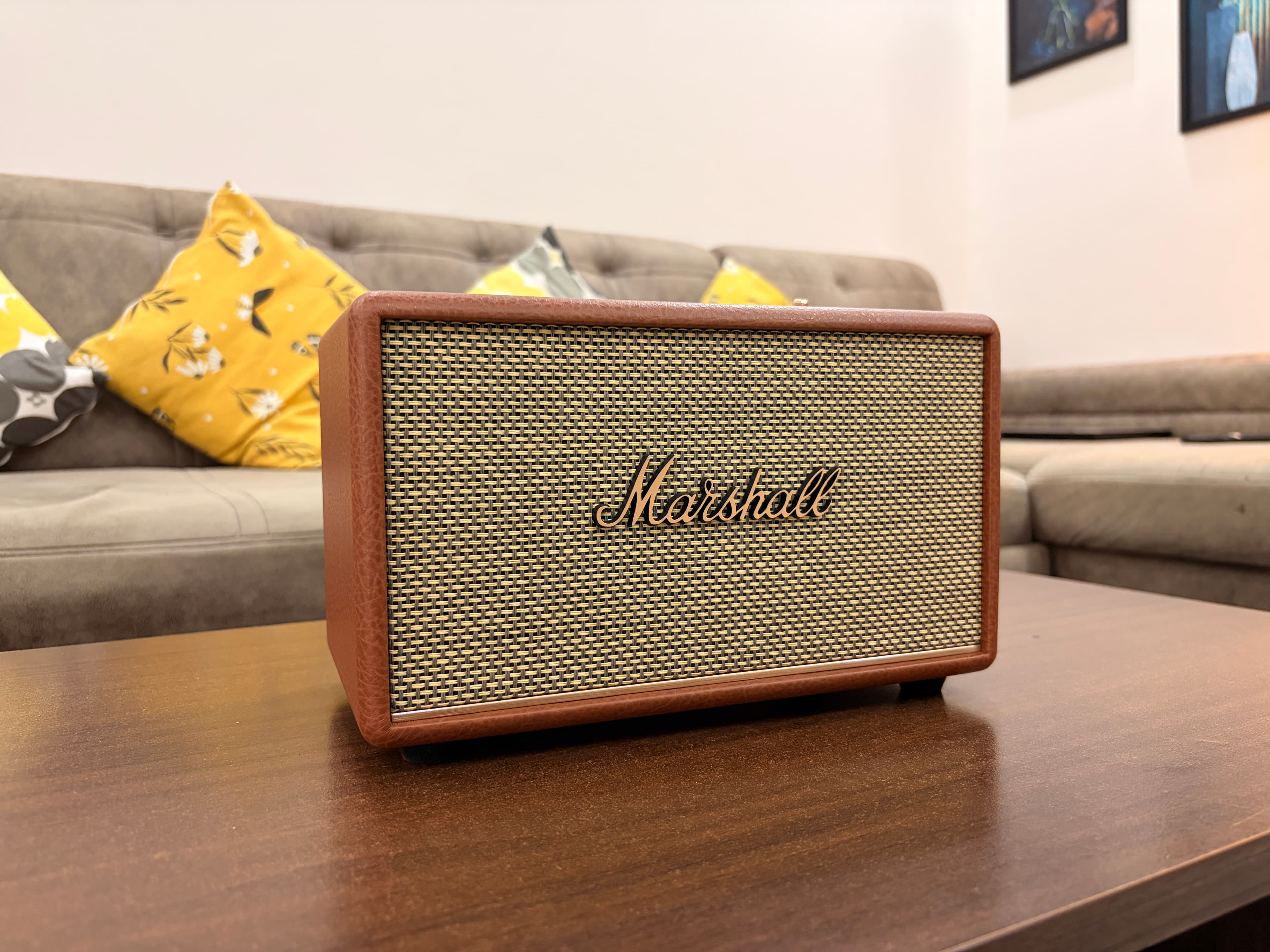
Marshall Acton III Review: Outstanding Sound, Stunning Design — Worth Every Rupee at a Sale Price
The Marshall Acton III delivers concert-level clarity and punchy controlled bass in a vintage package — best caught at a sale price, but hard to argue with either way.
I spotted the Marshall Acton III during Amazon's Prime Day sale at ₹19,500 — almost ₹9,000 below its regular listing — and after weeks of daily listening across genres, I can say this confidently: it is the best-looking, best-sounding home speaker I have had in my living room. The regular price is a harder sell, but the sound makes a strong argument even then.

Marshall Acton III Bluetooth Speaker
The Marshall Acton III is a mains-powered home Bluetooth speaker delivering 60W through a one-woofer, two-tweeter driver setup. It suits serious music listeners who want concert-level vocal clarity, a controlled punchy bass, and a vintage aesthetic that looks as good as it sounds — best value when caught at a sale price below ₹20,000.
Marshall Acton III Design and Build: A Showpiece That Earns Its Place
The first thing that strikes you is how instantly premium this speaker feels. The front grille has a woven fabric texture that runs edge to edge, and the Marshall script logo sits front and centre in gold — it does not look like a speaker as much as it looks like an amplifier straight off a concert stage. The outer shell has a leather-like texture that is tactile and warm, nothing like the plastic housings you find on most home audio products at any price.
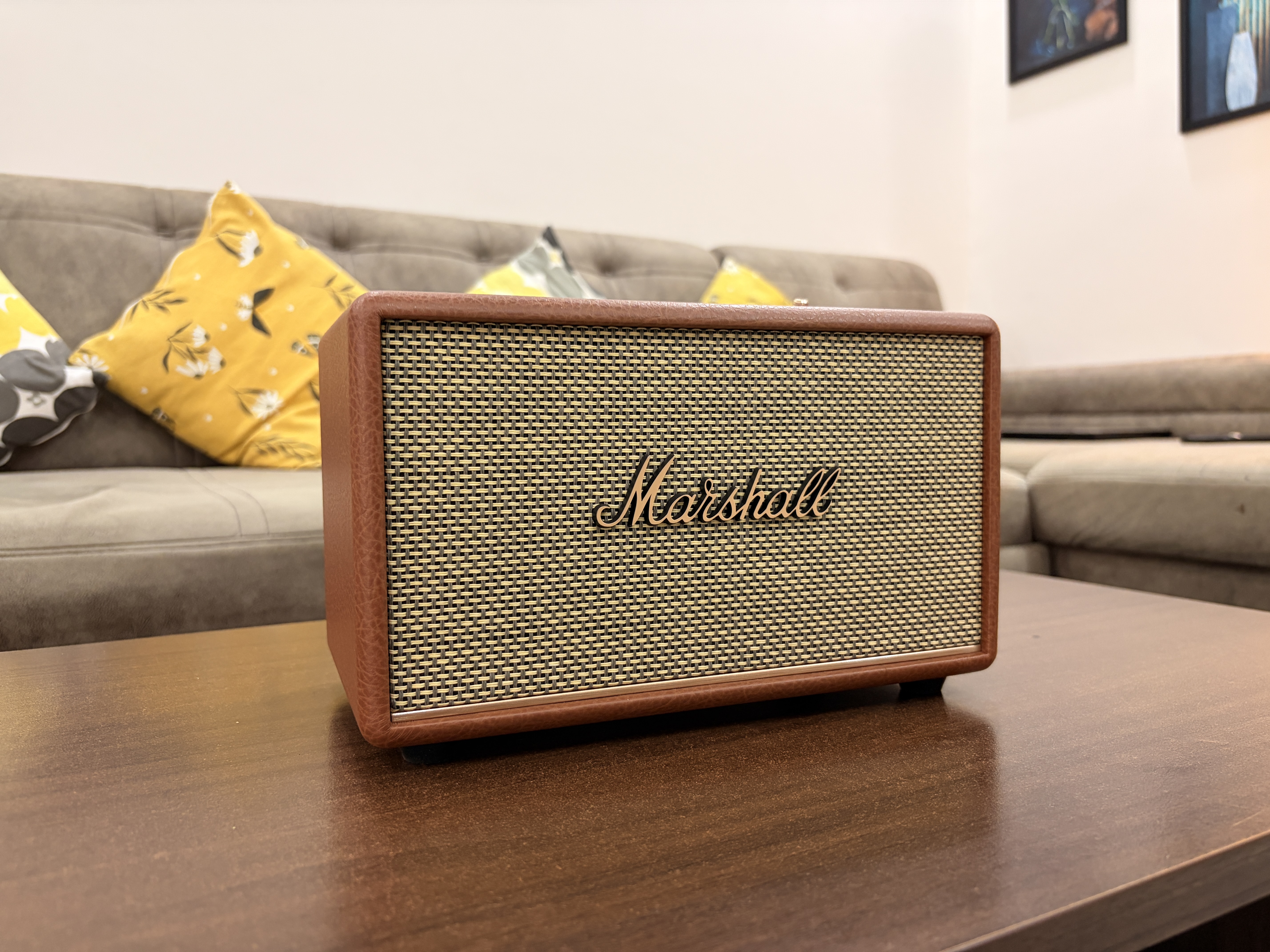
This is a heavy speaker. At just under 3 kg, once you place it on a table or shelf, it stays exactly there. Four rubber pads on the underside grip the surface firmly and prevent any vibration-induced sliding even at high volumes. Set it on a bookshelf and it looks like a deliberate design choice, not an appliance you tucked into a corner.
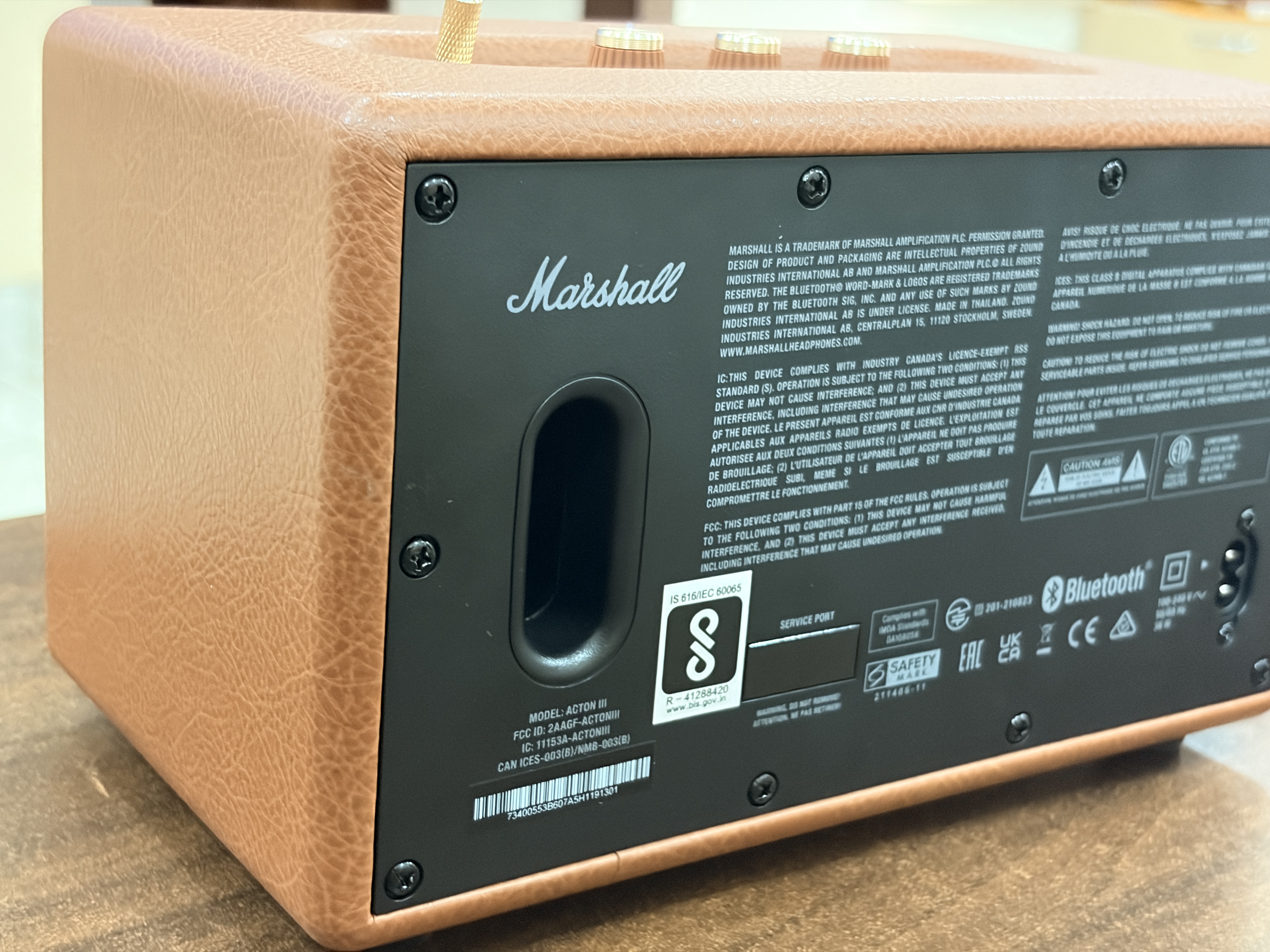
The back panel is just as considered. There is a passive radiator port — a slot that helps extend bass response from the sealed enclosure — along with the power connection and a service port. The whole rear face has the same aesthetic attention as the front, right down to the four exposed screws that make it feel like something you could open and maintain, not a sealed black box.
The Acton III is a mains-powered speaker — there is no internal battery. It needs to stay plugged in at all times, which means it lives on your desk or shelf rather than travelling with you. If you want the same sound in a portable package, Marshall's Kilburn III is the closest equivalent at roughly ₹35,000–₹40,000.
Marshall Acton III Controls: Physical Knobs Done Right
The top panel is where the Acton III separates itself from virtually every other speaker in this segment. Three large machined knobs handle volume, bass, and treble independently — dedicated controls for each, not a single EQ knob that cycles through modes.
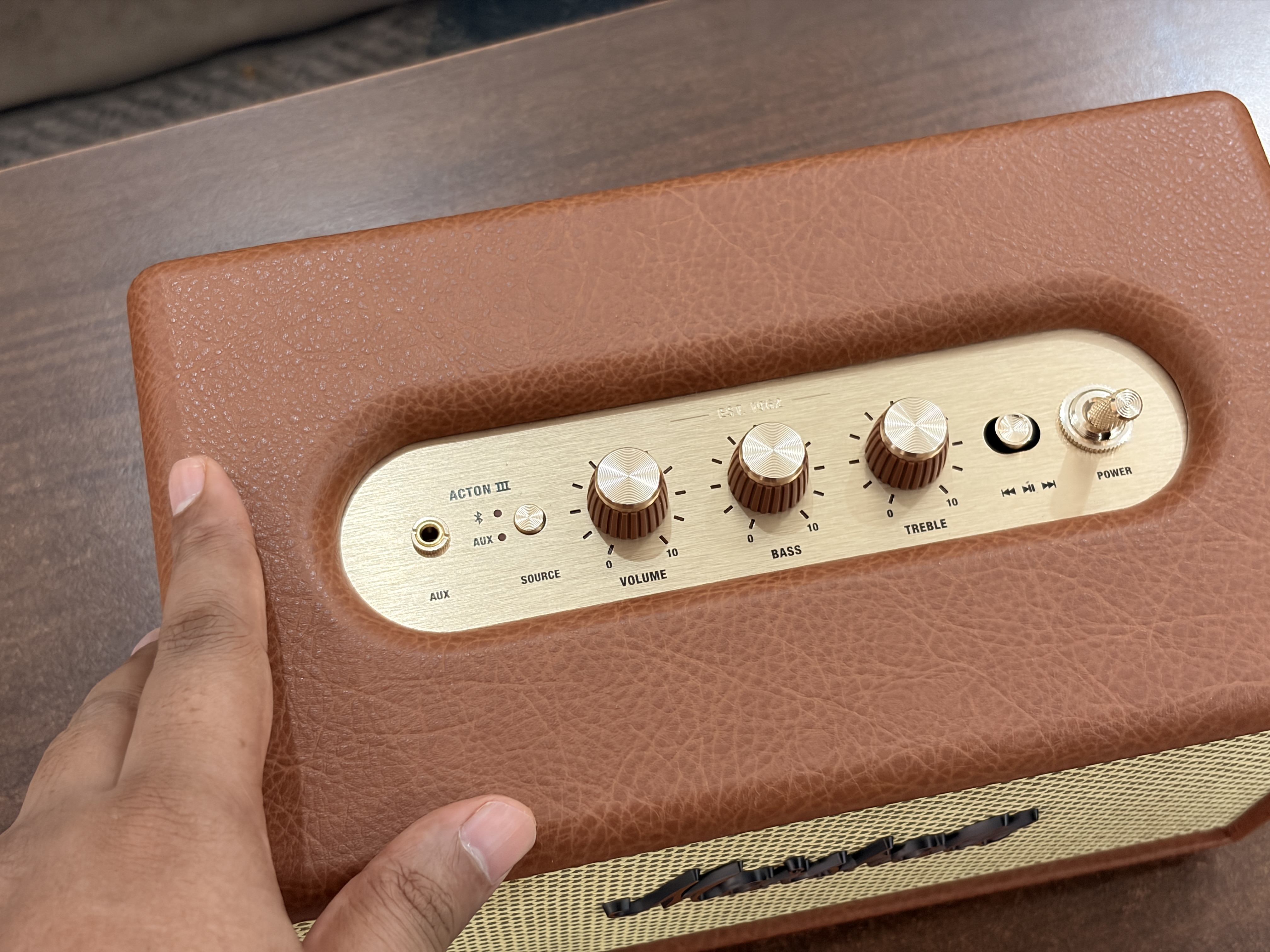
What makes these knobs genuinely special is that they have no physical stop. You can keep turning them in either direction without any resistance — the adjustment is digital, and the red indicator mark on the knob face tells you where you are. This is how older tape recorders worked before physical stops became the norm, and it gives the Acton III a tactile quality that feels deliberate rather than budget-constrained.
Beside the knobs is the power toggle — a gold metal lever that clicks into place with a satisfying, mechanical snap. There is no startup chime, no boot sound, no LED sequence. You flip the switch and the speaker is on. You know because the switch is in a different position, not because the speaker announced itself.
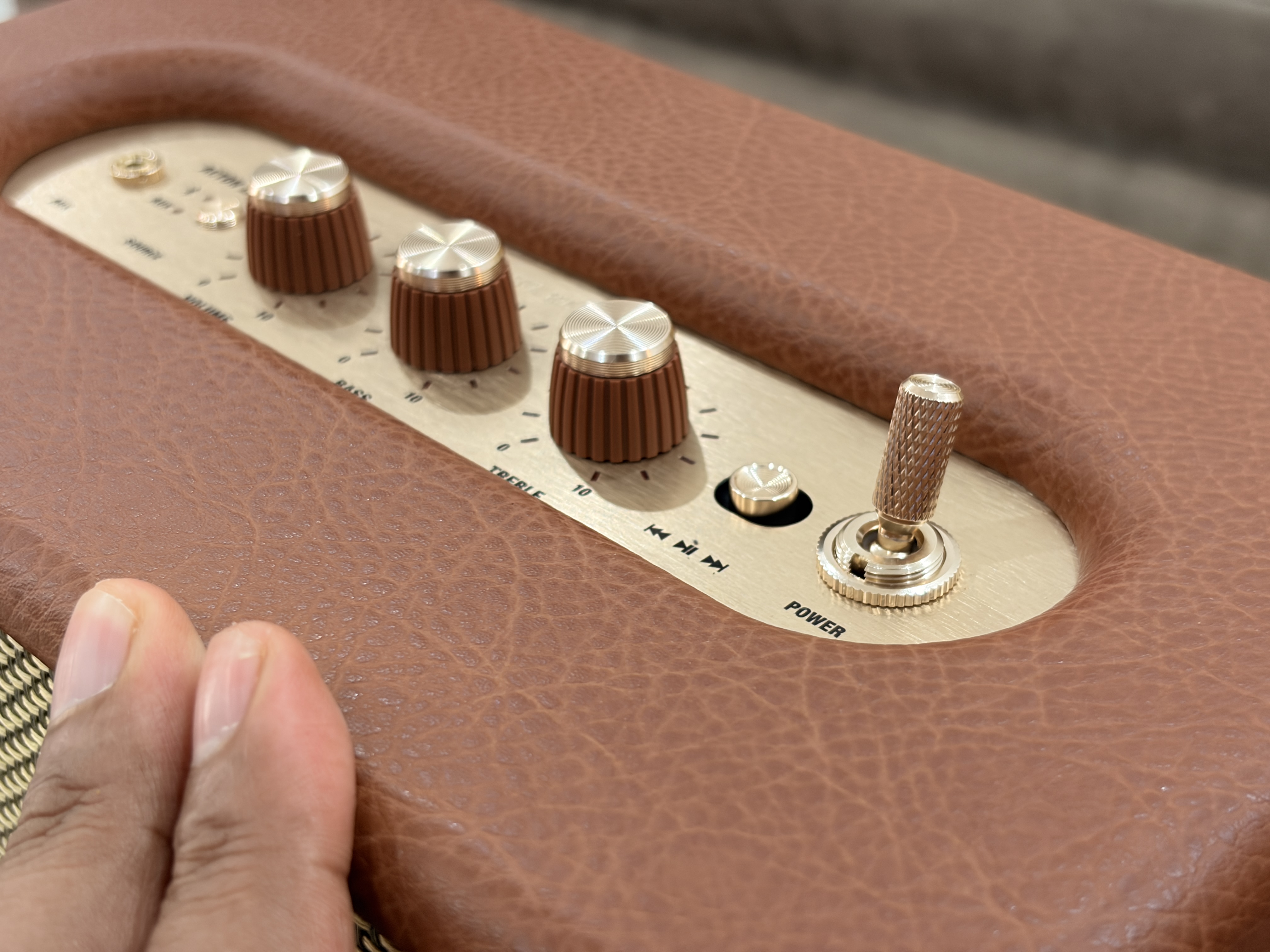
A small source selector button switches between Bluetooth and AUX inputs. Next to it is the 3.5mm AUX port and a play/pause and track-skip button for controlling music from the speaker itself when paired via Bluetooth.
Marshall Acton III Connectivity and App
Bluetooth 5.2 handles the wireless connection. This is not the latest standard — Bluetooth 5.3 and 5.4 are available in newer speakers — but in real-world use across a medium-sized living room, the connection was solid and consistent with no dropouts.
The AUX input is where the Acton III can genuinely shine for audio quality. If your source device supports lossless audio output and you use a quality 3.5mm cable, the difference over Bluetooth is audible — more detail, more headroom, more of everything. Most phones have removed the headphone jack, so you will need a USB-C to 3.5mm cable to make use of this input, but it is worth having.
The Marshall app is straightforward — almost to a fault. Once paired, it shows a digital representation of your speaker and gives you access to bass and treble sliders that mirror the physical knobs on top. The more useful function is firmware updates: I ran one shortly after unboxing and the process completed in a few minutes with no issues. Beyond that, there is genuinely little reason to have the app open during regular listening — the physical controls handle everything.
For late-night listening, pull the bass knob back by about 20% and raise treble slightly. The vocal and instrument detail at lower volumes is one of the Acton III's strongest qualities, and reducing bass helps it stay clear rather than getting muddy at quieter levels.
Marshall Acton III Sound Quality: The Reason You Buy This Speaker
This is where the Acton III earns everything it asks for.
The total output is 60W — 30W dedicated to the woofer and 15W each to the two tweeters — and it shows. At 50% volume in a standard living room, the sound fills the space completely. Pushing past 70% starts to feel genuinely excessive for anything but a party setting. I never tested it at maximum because the neighbours would have had opinions.
The bass is the defining characteristic, and it deserves a careful description. This is not a subwoofer-style bass that shakes the furniture or dominates everything around it. It is a controlled, punchy low end — you can feel it when you are seated nearby, especially on tracks with a strong kick drum or bass guitar, but it never bleeds into the mids or turns muddy. Sit on a sofa across the room and there is a physical quality to it that most portable and even many home speakers simply cannot produce.
Vocal clarity is where this speaker made me genuinely stop and pay attention. There is a quality to mid-range reproduction here — voices, guitars, flutes, strings — where you hear things in familiar songs that you did not notice before. It does not sound like a speaker in the traditional sense; it sounds like sound filling the room from a source rather than a point. Rock, hip-hop, acoustic, and classical all translate well. Lossless audio via the AUX input takes that further still — the separation between instruments at that level of detail is what serious music listeners are paying for.
Comparing it to Bose in the same tier: both are clear, both have quality bass. The Marshall's bass is tighter and more controlled; Bose tends toward a fuller, slightly warmer low end. Which you prefer is a matter of taste, but for accuracy and clarity the Acton III has an edge.
✓ Pros
- ✓Exceptional vocal and instrument clarity — genuinely concert-like at volume
- ✓Three dedicated physical knobs for volume, bass, and treble
- ✓Satisfying vintage aesthetic that looks at home in any living room
- ✓60W output fills large rooms with no strain
✕ Cons
- ✕No battery — must stay plugged in at all times
- ✕AUX requires a separate USB-C to 3.5mm cable for most phones
- ✕App adds little beyond firmware updates
The Marshall Acton III is built for one kind of person: someone who listens to music seriously, wants a speaker that looks as good as it sounds, and is happy to leave it on a shelf at home. At ₹19,000–₹20,000 during a sale, it is an outstanding buy. At the regular ₹27,990 it is still a considered purchase — the sound quality and build justify the price. The only clear reason to look elsewhere is if you need portability (look at Kilburn III) or a more compact footprint (Sonos Era 100 or 200).
FAQ schema emitted for Google rich results

Vishal Pratap
A technical writer by profession, a video creator by hobby, and a photography enthusiast.
Watch on YouTube →Related Articles
JBL Flip 7 Review: Outstanding Sound, But Only Worth It at the Right Price
The JBL Flip 7 delivers deep bass and room-filling volume with IP68 protection — but at its regular price, it's a hard sell over the cheaper Flip 6.
Portronics Muffs A3 Review: The Best Wireless Boom-Mic Headphone at ₹1,500 — With Some Real Trade-offs
The Portronics Muffs A3 is the only wireless boom-mic headphone under ₹2,000 — solid for Zoom calls, but comfort and call quality have real limits.

MacBook Air M5 Too Expensive? These Copilot+ Laptops Are Worth the Switch (India, 2026)
Apple raised MacBook Air M5 prices in India by ₹30,000 overnight. These five Copilot+ thin-and-lights now make a stronger case than ever — OLED displays, AI hardware, and all-day battery at significantly lower prices.